

Why British summers are getting hotter — and what it means for your home
The data is clear. UK summers are warming faster than almost anywhere in Europe. We've charted the numbers from 1980 to 2050 — and the picture is harder to ignore than you might think.
The numbers tell the story
The UK has been warming at around 0.25°C per decade since the 1980s. That might sound modest — but the effect on summer heat is anything but.
Four of the UK’s five hottest years on record have all happened in the last four years.
Summer 2025 was the hottest on record — a mean temperature of 16.10°C, smashing the previous record set just seven years earlier in 2018. The year before that, 2022, saw the UK’s first ever temperature above 40°C. And all ten of the UK’s hottest years on record have now occurred in the last two decades.
The chart below shows what this looks like in practical terms — not annual averages, but actual hot days. Days where it’s too warm to sleep. Days where working from home becomes genuinely difficult. Days where elderly relatives need checking on.
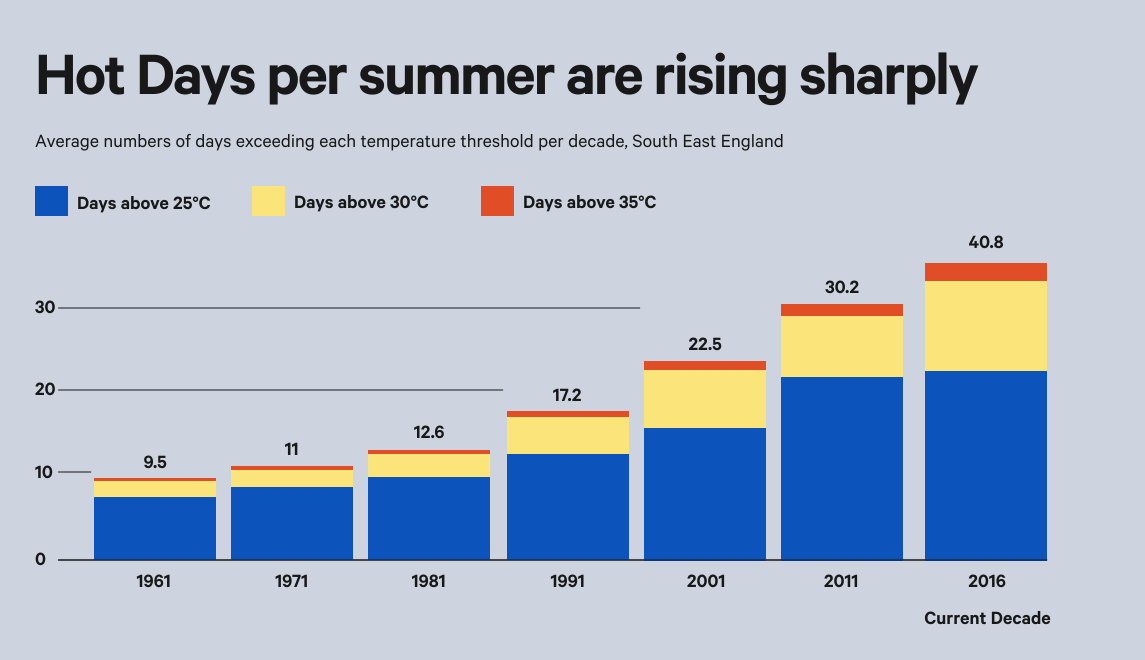
Average hot days per summer decade, South East England · Met Office State of the UK Climate 2025
The most recent decade — 2016 to 2025 — averaged over 40 hot days per summer in the South East. That’s more than four times the figure for 1961 to 1990. Days above 35°C, which were essentially unheard of before 2000, now happen every summer.
This isn’t going to reverse
The Met Office’s climate projections are unambiguous. UK summers will continue to warm. The only question is by how much.
- By the 2040s, summers as hot as 2003 — which felt like a once-in-a-generation catastrophe — are projected to be normal.
- By mid-century, summers as hot as 2018 could occur every other year.
- The chance of reaching 40°C is now over 20 times more likely than it was in the 1960s.
- In the South East, the hottest day of the year is already 4.5°C hotter than it was a few decades ago.
The South East warms faster than the rest of the UK. If you live in London, West Sussex, Kent, or Surrey, these figures apply directly to you — and your home.
Why your home isn’t coping
British homes were built for a different climate. The insulation that keeps your house warm in January traps heat in July. Victorian brick walls absorb heat all day and release it at night — exactly when you’re trying to sleep. Modern new-builds with large south-facing glazing can overheat worse than older properties. Only around 5% of UK homes have air conditioning — compared to over 90% in Japan and around 70% in the United States. The UK is not a hot country by historical standards. But it is becoming one. The housing stock hasn’t caught up.
A summer as hot as 2025 is now 70 times more likely than it would be in a natural climate.
For most people, the immediate impact is sleep. Cognitive performance drops measurably when bedroom temperatures exceed 28°C. Sustained poor sleep during heatwaves compounds heat stress — and for the elderly, young children, and people with heart or respiratory conditions, heat at home is a genuine health risk. The first two heatwaves of 2026 alone are estimated to have caused around 2,700 heat-related deaths in London, its commuter belt, and the wider South East.
What Temlo does about it
We’re not going to pretend there’s no irony in selling air conditioning during a climate crisis. There is. We talk about it openly on our climate page.
What we can control is how we do it. Every system Temlo installs is:
- A-rated for energy efficiency — not the cheapest unit, the most efficient one for your room
- Inverter-driven — runs at reduced power once it reaches your target temperature, up to 40% more efficient than older systems
- R-32 refrigerant — a global warming potential less than a third of older R-410A systems
- Installed by REFCOM-certified engineers — legal compliance, zero refrigerant released to atmosphere
And a portion of Temlo revenue goes to organisations fighting climate change.
The most effective thing you can do alongside installation is switch to a renewable electricity tariff. On a 100% renewable tariff, your AC system’s operational carbon footprint drops to near zero.
Get a free estimate at temlohome.com · Transparent pricing · REFCOM-certified installers · Fast response.
Sources: Met Office State of the UK Climate 2025 · Met Office UKCP18 Climate Projections · UK Health Security Agency·
Environmental Audit Committee
See our other helpful guides

How much does air conditioning cost in the UK?
Most AC companies make you call before they'll discuss price. We don't. A complete breakdown of installation costs for 2026 — equipment, labour, VAT, and what affects the final number.
Read more →
Do I need planning permission for AC in the UK?
The answer depends almost entirely on your property type. Most houses don't need it. Flats, listed buildings, and conservation areas are different. Here's the complete picture — including what to…
Read more →Get your own price estimate.
Takes 60 seconds. No personal details until the end.
Get a free estimate Certified installers
  Fast response
  Fixed quote before install